

8 modules · 23 interactive tools

Food Truck Entrepreneurship

From first idea to first year on the road. A hands-on course built for the real decisions food truck owners actually face.

In Ohio high school CTE classrooms since September 2026

★ 44 resources included
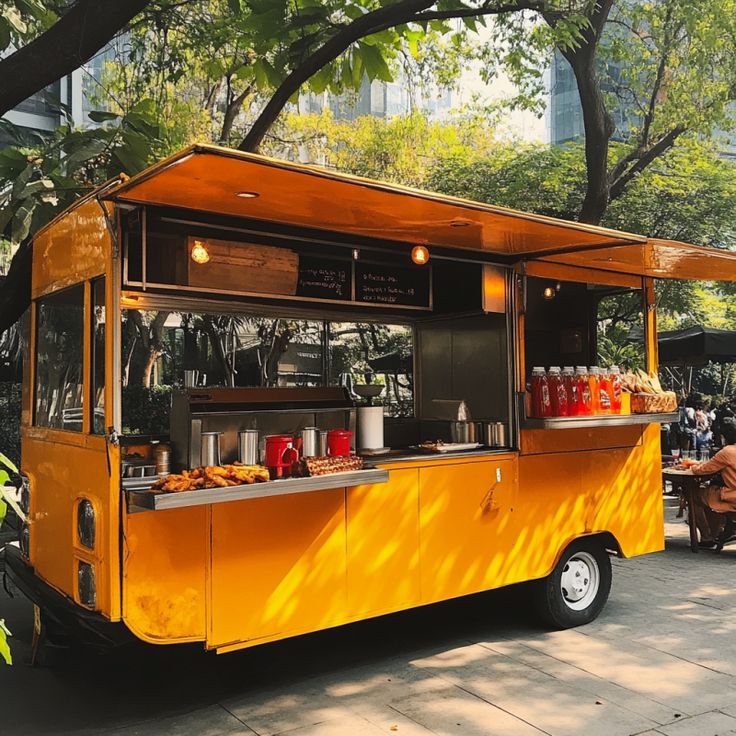
Food truck serving customers at a busy street location
23+ Interactive tools
8Core modules
23+Interactive tools
25+Video lessons
44Downloadable resources

Overview

Most business courses teach concepts. This one gives you a truck to run.

Across eight modules, you build a real business as you go. You cost your own menu, size your own loan, write your own job descriptions, and decide whether a real event is worth working.

Every tool produces something you keep: a downloadable business plan, a costed menu, a funding recommendation, and a repayment schedule.

Food truck entrepreneur reviewing plans Course program materials on a tablet

By the Numbers

Everything inside the course

8modules, start to finish
25+instructional videos
23+interactive tools and case studies
44downloadable resources (22 personalized PDFs + 22 templates)
1capstone project

What Makes This Course Different

Built for operators, not observers

You Build as You Learn

22 interactive tools generate a personalized PDF from your own numbers (costed menu, loan repayment schedule, cash flow statement, funding recommendation), plus Excel workbooks, job description templates, and real government permit guides.

One Story, Told Across the Whole Course

Case studies follow Bill, a recurring food truck owner, through real decisions across multiple modules.

Grounded in Reality

Uses real permit fact sheets and plan check guidelines from LA County, NYC, and Portland, plus actual SBA funding guidance.

A Capstone That Actually Synthesizes

"Your First Year Running the Truck": 8 connected real-world decisions where each choice shapes the next, ending in a personalized "Year in Review."

What You'll Get

Everything in one place

No fluff, no filler. Every resource is designed to save you time and money in the real world.

25+ video lessons

Structured instruction across all 8 modules, from startup costs to event logistics.

Excel workbooks

Ready-to-use spreadsheets for cost tracking, pricing, cash flow, and financial planning.

22 personalized PDFs

Generated from your own numbers: costed menu, funding recommendation, repayment schedule, and more.

Lifetime access

All future updates included. Come back whenever you need a refresher or a new download.

WHAT LEARNERS SAY

Practical, clear and worth recommending

From course evaluations of the Food Truck Entrepreneurship micro-credential.

In-depth insights, particularly on permit-related topics. I would very likely recommend this micro-credential.

Milciades Peguero

ARKANSAS STATE UNIVERSITY

The examples of menus and ideas provided were especially helpful.

Paulisha Jordan

CLEVELAND STATE UNIVERSITY

Logically sequenced but also highly engaging.

Tre Hampton

ARKANSAS TECH UNIVERSITY

Straightforward, well-organized, and logically sequenced.

Nicholas Morin

LAKE SUPERIOR STATE UNIVERSITY

Visually appealing but also user-friendly. I gained valuable skills that directly applied to my work life.

Luiz Ferreira

MERCY COLLEGE

Sample Tools

Try before you enroll

These are previews of the 23 interactive tools inside the course. Adjust the sliders and see your numbers update live.

Try a sample tool from Module 1

Startup Cost Calculator

What it really costs to get a food truck on the road.

Total startup cost
$105,000
Try a sample tool from Module 3

Loan Repayment Calculator

Size your funding and see monthly payments and total interest.

Monthly payment
$0.00
Total interest: $0
Try a sample tool from Module 4

Menu Pricing Tool

Recipe costing and food cost percentage. Pick a sample item.

Suggested menu price
$0.00
Gross margin per item
Try a sample tool from Module 8

Is This Event Worth It?

Run the numbers before you commit to a festival or pop-up.

Break-even units
42 units
Projected revenue: $2,400
Est. profit
Worth it

Curriculum

Eight modules, zero filler

Expand each module to see what you'll learn.

What it really costs to get a food truck on the road, and the mistakes that sink new owners early.

Competitor analysis, customer profiles, brand identity, a working social media plan.

Funding sources, loan mechanics, cash flow management, a personalized funding recommendation with a document checklist.

Recipe costing, food cost percentage, menu engineering, consistency at scale.

Sourcing, storage, waste reduction, par levels, with a running case study.

Employee handbooks, job descriptions, hiring, pay and benefits, real workplace situations.

Permits, health department requirements, insurance, advocating for fair regulations.

Finding events, running the numbers on whether one's worth working, shift logistics.

8 connected decisions pulled from every module, plus a personalized review of what's worth revisiting.

Capstone Preview

Your choices shape what comes next

Decision 1 of 3

IN THE CLASSROOM

Backed by educators

Running in an Ohio high school CTE classroom in the 2026-27 school year.

Austintown Local Schools

Offers the course at Fitch High School, launched in September 2026, and intends to continue offering the course and make the credential available to eligible students.

Jeffrey S. Swavel, Director of Pupil and Staff Services. Letter of support, October 28, 2026.

Educational Service Center of Eastern Ohio

Supports the certificate as an industry-aligned opportunity in business planning, financial management, marketing and operations, and encourages employers to consider certificate holders for relevant positions.

Sandy Furano, Director of Career Counseling Services. Letter of support, October 29, 2026.

Hiring decisions remain at each employer's discretion.

Ready to Build Something Real?

Every tool, every worksheet, every calculator in this course is yours to keep. Start today, and walk away with more than a certificate. Walk away with an actual plan.

Have more questions? Get in touch

8 modules · 23 tools · 44 downloadable resources